
The "95th Percentile Male" crash test dummy is a standardized human surrogate used in automotive crash safety testing. It is designed to simulate the motion, biomechanical response, and potential injury risks of a larger-than-average adult male occupant during a vehicle collision. The term "95th percentile male" indicates that the dummy’s physical dimensions and body parameters—such as height, weight, and various segmental measurements—exceed those of approximately 95% of the adult male population. It does not imply that the vehicle’s crash safety performance is at a "95% level."
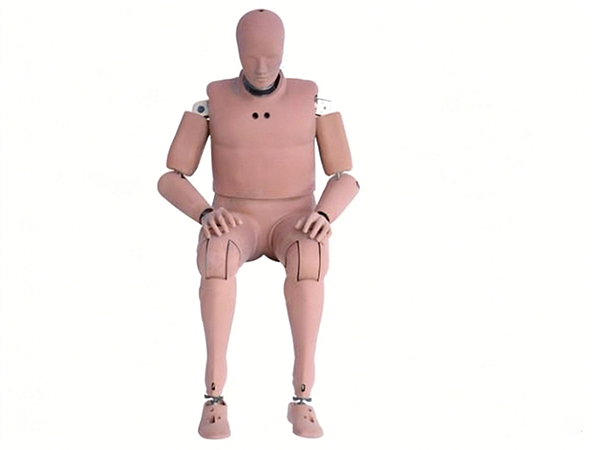
The 95th percentile male crash test dummy is a standardized human surrogate employed in automotive crash testing and occupant injury assessment. Its overall structure is engineered based on the dimensions, mass distribution, and biomechanical characteristics of an adult male. It consists of components representing the head, neck, thorax (chest), abdomen, pelvis, and upper and lower limbs, integrated with an internal skeletal framework, joint mechanisms, and a sensor-based measurement system. These components are mechanically linked to form a complete human model, which simulates the movement, deformation, and loading experienced by various parts of an occupant's body during a collision. The head—a critical component—replicates the mass, shape, and inertial properties of a human head; it typically houses tri-axial accelerometers that measure acceleration in different directions during an impact, providing data for the calculation of head injury criteria. The neck, which connects the head to the thorax, simulates the biomechanical response of the human cervical spine and surrounding tissues; it is designed to exhibit specific bending, tensile, and compressive characteristics, with force and moment sensors used to measure the loads applied to the neck during a crash. The thorax comprises the thoracic vertebrae, ribs, sternum, and associated elastic structures; it simulates the compression of the rib cage when subjected to forces from seatbelts, airbags, or vehicle interior components. It is generally equipped with displacement sensors and accelerometers to capture data on thoracic compression and dynamic response. The abdominal section is designed to simulate the compression and deformation characteristics of human soft tissue. It is typically constructed from materials that offer a degree of compliance and energy-absorption capacity, allowing for the study of how seat belts and vehicle interior components interact with the abdomen during a collision. The pelvic region, located at the base of the torso, simulates the mass distribution, structural stiffness, and load-transmission properties of the human pelvis, while also serving as the connection point between the torso and the lower limbs. The upper limbs—comprising the shoulders, upper arms, forearms, elbows, and hands—and the lower limbs—consisting of the thighs, knees, lower legs, ankles, and feet—are attached to the torso via mechanical joints. These components allow for the simulation of the relative motion, bending, and loading of the limbs during a crash. Furthermore, the dummy features an internal skeletal and joint system—composed of metal support structures, connecting shafts, and mechanical joints—which maintains the overall human form, structural stability, and range of motion. Sensors and data acquisition systems are central to measuring crash responses; these typically include accelerometers, force sensors, torque sensors, and displacement sensors, which capture critical data such as head acceleration, neck loads, chest compression, pelvic acceleration, and the forces exerted on the femurs and tibiae. Through the coordinated interaction of these various components, the 95th Percentile Male Crash Test Dummy provides a comprehensive simulation of the kinematics and biomechanical responses of a large adult male occupant during a vehicle collision. This serves as a vital source of experimental data and technical support for evaluating vehicle passive safety, optimizing occupant restraint systems, and analyzing the risk of human injury.
The 95th percentile adult male crash test dummy effectively addresses the limitations of standard-sized crash dummies when evaluating the safety of larger occupants. In real-world traffic accidents, occupants exhibit significant variations in height, weight, body proportions, and skeletal or soft-tissue structure. These differences directly influence an occupant’s trajectory during a collision, the points of contact between the body and the vehicle interior, and the loads experienced by various parts of the body. The 95th percentile male dummy represents larger individuals within the adult male population, with physical dimensions that exceed those of approximately 95% of the reference male demographic. The introduction of this type of crash test dummy enables a more comprehensive study of the kinematic responses of larger-bodied occupants during a collision. It allows for the analysis of safety risks that might not be adequately captured by standard-sized dummies, thereby broadening the scope of automotive crash safety evaluations to better account for occupants of varying physical builds. In the event of a vehicle collision, inertia causes occupants to move significantly relative to the vehicle; body parts—such as the head, neck, chest, abdomen, pelvis, and limbs—may be subjected to forces from components like seatbelts, airbags, the steering wheel, the dashboard, and vehicle doors. Because larger occupants possess different physical dimensions and mass distributions compared to standard-sized individuals, their kinematics and the forces exerted on their bodies during a collision may also differ. For instance, larger physical dimensions can alter the relative positioning between an occupant and the steering wheel, dashboard, or airbags, while greater body mass can influence the inertial loads experienced by various body segments. Consequently, utilizing a 95th percentile male dummy in crash tests and numerical simulations allows for the examination of critical responses—such as head acceleration, neck loading, chest compression, pelvic motion, and forces on the lower extremities—providing a vital foundation for analyzing injury mechanisms and identifying potential areas of risk.
The 95th percentile male crash test dummy serves not only as an essential tool for evaluating the crash safety of larger adult male occupants but also as a key technical instrument for research in automotive crash biomechanics, the optimization of occupant restraint systems, the analysis of human injury risks, and finite element simulations. Its application in the development of automotive passive safety systems facilitates more thorough research into the protection of occupants with diverse physical builds, enhances a vehicle’s ability to protect larger occupants, and provides critical support for achieving more comprehensive, reliable, and representative safety designs for vehicle occupants.
