
The 50th Percentile Male Side Impact Dummy is a human surrogate device specifically designed for automotive safety testing. It is primarily used to simulate the motion and potential injuries of an adult male occupant during a side-impact vehicle collision. The dummy is engineered based on the dimensions, weight, and body proportions of a 50th percentile adult male—representing the median of the adult male population. Its structure replicates key human body parts, including the head, neck, chest, abdomen, pelvis, spine, arms, and legs. Equipped with sensors at critical locations, the dummy measures acceleration, impact forces, deformation, and other biomechanical parameters during a collision.
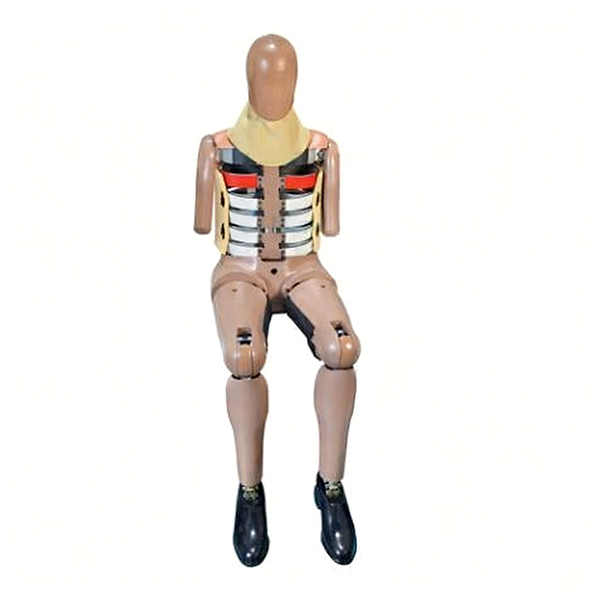
Simulation of Human Anatomy: The dummy is designed to match the dimensions, weight, mass distribution, and proportions of a 50th percentile adult male. It replicates major anatomical regions—such as the head, neck, chest, abdomen, spine, pelvis, and limbs—connected by joints and structures that mimic human tissue. This configuration ensures that, when subjected to external impact, the dummy responds in a manner closely approximating the movement characteristics of a real human body. Simulation of Impact Dynamics: In a side-impact test, the dummy is positioned and secured on a vehicle seat according to specified protocols. When the vehicle is struck from the side, the door, side-structure, and other interior components deform, exerting impact loads on the dummy. In response, the dummy’s various body segments undergo displacement, rotation, and deformation—determined by their respective mass, structural stiffness, and joint characteristics—thereby simulating human motion during a side-impact event. Acceleration Measurement: Accelerometers are typically installed in key areas of the dummy, such as the head, chest, and pelvis. During a collision, these sensors detect acceleration changes in various directions, converting the dynamic mechanical motion into electrical signals. By recording how acceleration changes over time, analysts can evaluate the intensity of the impact and the resulting motion of different parts of the human body. Principles of Impact and Load Measurement: Key structural components within the dummy are equipped with force sensors or load-measuring devices to detect the forces exerted on various body parts during a collision. For instance, when the chest or pelvic region is compressed by a vehicle door or side-impact protection structure, the resulting forces are captured. Sensors convert these mechanical loads into electrical signals, which are then transmitted to a data acquisition system for analysis of the impact loads sustained by the human body. Principles of Chest Deflection Measurement: The chest is particularly susceptible to compression injuries during side-impact collisions. The dummy’s chest is typically fitted with displacement sensors or deflection-measuring devices to record the extent of compression and deformation during an impact. By analyzing the degree of chest compression, the rate of compression, and the forces applied, it is possible to assess the risk of injury to the human thoracic cavity and internal organs. Principles of Pelvic and Abdominal Load Measurement: In a side-impact collision, components such as interior door panels, side-structure elements, or the sides of seats may strike the pelvis and abdomen directly. The dummy utilizes force sensors, accelerometers, and other measuring instruments to record the impact loads and dynamic responses in these areas, enabling an assessment of potential injury risks to the pelvic and abdominal regions. Principles of Head Motion and Injury Assessment: During a side-impact collision, the dummy’s head may undergo lateral movement or rotation, and may come into contact with windows, doors, or other interior structures. Accelerometers mounted in the head record acceleration changes during the impact; these data, combined with kinematic parameters, are used to evaluate the severity of the impact to the head and the associated risk of injury. Principles of Data Acquisition and Signal Processing: Throughout a collision, various sensors embedded within the dummy simultaneously capture dynamic signals—such as acceleration, force, displacement, and deformation. These signals are transmitted via wiring to an external data acquisition system, where they undergo conditioning, filtering, conversion, and recording to produce a comprehensive set of crash test data. The data acquisition system tracks the changes in each measurement channel over the course of the collision, providing the foundation for subsequent analysis.
Enhancing Side-Impact Safety: By simulating the movement and forces experienced by an adult male occupant during a side-impact collision, the dummy allows for the measurement of impact loads on the head, chest, abdomen, and pelvis. This helps manufacturers identify safety vulnerabilities in a vehicle’s side structure, facilitating the optimization of crash-resistant body design. Assessing Occupant Injury Risk: Sensors embedded within the dummy collect data—such as acceleration, impact force, and chest deflection—during a collision. This data is used to analyze the potential severity of injuries to various body parts, providing an objective basis for evaluating vehicle crash safety. Validating Side Airbag Performance: Side-impact tests allow for the observation of interactions between the dummy and components such as side airbags, curtain airbags, and interior door trim. This enables the evaluation of airbag deployment positioning, timing, and cushioning effectiveness, informing the design and refinement of occupant restraint systems. Optimizing Vehicle Body Structure: By analyzing the deformation of doors, B-pillars, side panels, and other structural elements—along with the force responses of different parts of the dummy—developers can optimize structural strength, energy-absorption characteristics, and crash-force load paths, thereby improving a vehicle’s resistance to side-impact collisions.
The 50th Percentile Male Side-Impact Dummy is a critical tool in automotive side-impact safety testing. Its significance lies in its ability to simulate the realistic movement and force dynamics of an adult male occupant during a side-impact accident. By accurately capturing the dynamic responses of key body regions, it provides a scientific foundation for assessing occupant injury risk and analyzing vehicle safety performance. Beyond assisting manufacturers in optimizing body structures, airbags, and occupant restraint systems, this equipment enhances the standardization, objectivity, and reliability of crash testing. It plays a vital role in safeguarding the lives of vehicle occupants, advancing passive safety, and driving the overall development of automotive safety technology.
