
A "Crash Test Dummy (based on Chinese anthropometric data)" is a crash test dummy designed according to the body dimensions and biomechanical characteristics of the Chinese population. It is used to simulate human movement and injury patterns during traffic accidents, providing experimental data for automotive safety design, crash performance evaluation, and research into occupant protection.
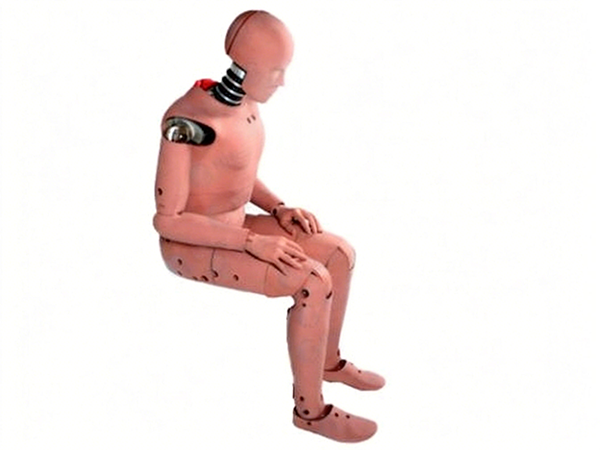
Vehicle Crash Safety Testing: Used in frontal, side, rear, and other types of crash tests to simulate the movement of drivers and passengers during traffic accidents. It collects data—such as acceleration, applied force, and displacement—for various parts of the human body to evaluate the overall crash safety performance of a vehicle. Occupant Protection Evaluation: Used to study the forces exerted on the head, neck, chest, abdomen, pelvis, and limbs during a collision, and to analyze potential injury risks under various crash conditions, providing a basis for improving occupant protection. Seatbelt Performance Testing: Used to test the restraint effectiveness of seatbelts during a collision, analyze the forces applied to the chest, abdomen, and pelvis, and optimize the design of seatbelt structures, pretensioners, and load limiters. Airbag System Testing: Used to evaluate the deployment and protective performance of driver, passenger, and side airbags during a collision, while studying the contact, impact, and energy absorption between the airbags and the human body. Vehicle Seat and Headrest Safety Testing: Used to study how seats and headrests support and protect the torso, neck, and head during a collision, and to evaluate the impact of seat structure, headrest positioning, and restraint systems on occupant safety. Vehicle Interior Safety Research: Used to analyze contact between the human body and components such as the steering wheel, dashboard, doors, windows, and other interior structures. This helps assess potential injuries caused by the vehicle's interior and provides a reference for the design of interior materials and structures. New Energy Vehicle (NEV) Safety Testing: Used in crash safety research for new energy vehicles to evaluate how well electric vehicles protect drivers and passengers during a collision. It provides experimental data for the safety design of vehicle body structures, battery pack protection systems, and occupant restraint systems. Human Biomechanics Research: Used to study the motion patterns, force characteristics, and injury responses of various human body parts under impact loads, as well as to analyze how factors such as body dimensions, weight, and proportions influence the risk of collision-related injuries. Development of Automotive Passive Safety Systems: Utilized in the research, development, and optimization of seatbelts, airbags, seats, headrests, and other occupant restraint systems; test data from various collision scenarios help enhance the protective efficacy of these passive safety systems. Compliance Testing for Automotive Safety Regulations and Standards: Supports collision testing required by automotive safety regulations, technical standards, and testing protocols, providing an experimental basis for evaluating the safety performance of automotive products, verifying designs, and conducting certification testing. Automotive Research and Educational Experiments: Suitable for use by universities, research institutes, automotive engineering laboratories, and professional testing organizations to conduct research and teaching in areas such as vehicle collision dynamics, human biomechanics, traffic accident injury analysis, and vehicle safety technology.
Improving the Accuracy of Automotive Collision Safety Testing: Traditional crash test dummies are typically designed based on the body dimensions and structures of populations in specific countries or regions. Dummies designed using anthropometric data from the Chinese population more accurately reflect the height, weight, body proportions, and anatomical characteristics of Chinese individuals. This ensures that collision test results are more representative of the Chinese occupant population, making the test data better aligned with real-world requirements. Safeguarding the Lives of Vehicle Occupants: By simulating human motion and the forces exerted on the body during a collision, it is possible to analyze potential impacts and injuries to the head, neck, chest, abdomen, pelvis, and limbs. This provides a critical foundation for identifying safety risks, improving vehicle protective structures, and reducing injuries resulting from traffic accidents. Optimizing Automotive Passive Safety Systems: These dummies can be used to evaluate the protective performance of seatbelts, airbags, seats, headrests, and other occupant restraint devices. This assists automotive manufacturers in optimizing the structural design, positioning, and operational parameters of safety systems, thereby enhancing occupant protection across various collision scenarios. Promoting the Localization of Automotive Safety Design: Human dimensions and body proportions vary across different countries and regions. Utilizing crash test dummies that reflect the anthropometric characteristics of the Chinese population enables automotive manufacturers to tailor safety designs to the physical traits of Chinese consumers, thereby enhancing occupant protection within the specific context of the Chinese market. These dummies provide a foundation for the development of automotive safety regulations and standards: by capturing data on acceleration, applied forces, displacement, and other biomechanical parameters during a collision, they offer empirical evidence for refining vehicle crash safety assessment methods, human injury criteria, and relevant testing standards. Furthermore, they advance research in human biomechanics by simulating the dynamic response of various body parts to impact loads. This helps researchers investigate the relationships between human anatomical structure, impact forces, and potential injuries, providing essential data for predicting human injury, analyzing traffic accident trauma, and developing biomechanical models.
The significance of crash test dummies based on Chinese anthropometric data lies in their ability to more accurately simulate the biomechanical response of the Chinese human body during automotive collisions. They serve as a vital experimental basis for crash safety testing, the assessment of human injury risk, the optimization of occupant restraint systems, and the formulation of automotive safety standards. Beyond being an essential tool for the research, development, and testing of vehicle safety performance, these dummies are instrumental in improving occupant protection and driving the advancement of automotive safety technology.
